Can You Use an Extension Cord With the BYD Portable Charger? What to Know Before You Try
The portable charger that comes with a BYD is often too short for the parking spot, so owners ask about extending it. Automakers, including BYD's New Zealand arm, say not to use extension cords, and there are safer ways to solve the reach problem.
The portable charger that comes with many BYD models is often too short for the parking spot. Automakers, including BYD in New Zealand, tell owners not to use extension cords with it, so this article explains why and what to do instead.
Model scope: written with the BYD Atto 3 in the Philippines in mind. Other BYD models and markets may differ, so always check your own owner's manual.
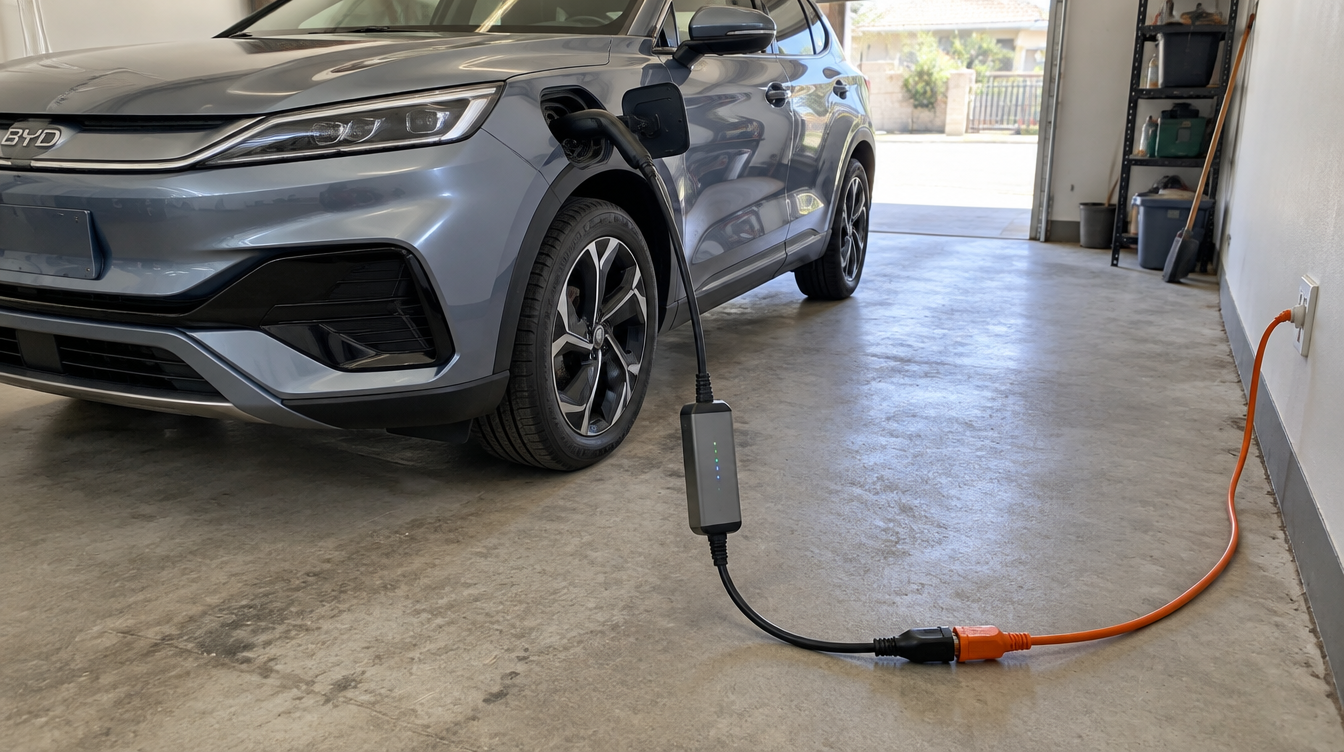
Illustrative image only. Actual vehicle appearance, features, and specifications may vary. The picture shows the setup this article advises against.
Why owners ask about this
The portable charger (a "Mode 2" cable with a control box) plugs into a household socket and charges slowly. Philippine press reports describe the Atto 3's portable charger as a 2.3 kW unit that takes roughly 15 to 21 hours to go from 10 to 80 percent. Because it is slow, the car often sits plugged in overnight or longer. If the nearest socket is far from the car, an extension cord looks like the easy fix.
What the official guidance says
BYD's official New Zealand FAQ says the 3-pin emergency charger should be plugged directly into the wall, and that multiboards and extension cords should not be used while charging. That page is for New Zealand, not the Philippines, so it is a reference point and not a statement about local terms.
We could not find a BYD Philippines page or manual that addresses extension cords, so please check your own manual and ask your dealer. Some third-party accessory shops quote the Atto 3 manual as warning against extension leads and adapters. We have not confirmed that wording against the manual itself, so treat it as unverified.
Other brands are very consistent:
- Kia's owner's manual tells owners not to use an extension cord or adapter with its portable charger.
- Tesla's Mobile Connector manual warns against extension cords, multi-outlet adapters, multi-plugs and conversion plugs.
- Kelley Blue Book reports that automakers warn against extension cords for EV charging because of overheating, fire and shock risk.
Why the risk is real
This is editorial analysis based on the sources above, not a BYD statement.
- Charging is a long, continuous load. A cord that is fine for a fan or a drill can run warm for ten hours or more.
- Most of the heat builds up at the plug and socket connections, not along the wire. A cord with thicker wire can still overheat at a loose or worn plug.
- Every extra connection adds resistance and one more place for heat to build up.
- Coiled, bundled or covered cords hold heat in.
- Cheap or old cords, and multi-outlet boards, are the highest-risk choices.
Community reports from owners of other EV brands describe melted plugs after using extension cords. These are individual experiences, not proof about BYD vehicles, but they show what the warnings are about.
Why we are not giving DIY wiring steps
Making or modifying a mains cord for an EV charger is electrical work. The right wire size, plug, socket, grounding and protection depend on the charger's rating, your building's wiring and the Philippine Electrical Code. A mistake can cause a fire, and it may also affect your warranty. For these reasons BYDPH.org does not publish step-by-step instructions for building an extension cord.
Safer ways to solve the reach problem
- Park so the cable reaches. If possible, position the car so the charge port is near the socket. Check where your car's port is before choosing a spot.
- Have a licensed electrician install a dedicated outlet close to where you park. It should be a socket that meets local standards and is used only for the car. BYD's New Zealand FAQ and other manuals advise plugging the portable charger directly into the wall.
- Consider a wall box. A 7 kW wall box on a dedicated circuit is the usual home option. One PH electrical contractor's guide says such an installation needs a dedicated circuit with ground-fault protection and engineer-signed plans. Ask your dealer or electrician what applies to your home or condo.
- Check the socket first. Do not plug the charger into a damaged, loose, warm or poorly grounded socket. Have an electrician inspect it if you are unsure.
- Ask the dealer. If you believe an extension is unavoidable, ask the authorized dealer or BYD Philippines in writing what they allow and whether it affects your warranty.
Warning signs: stop charging
Unplug and get help from a qualified electrician or your BYD service center if you notice:
- a warm or hot plug, socket or control box
- a burning or plastic smell
- discolored or melted plastic
- the charger repeatedly stopping or showing faults
Where to learn more
- BYD New Zealand FAQ (non-PH, official)
- Kia: precautions for the portable charger
- Kelley Blue Book: why not to use an extension cord for EV charging
- Tesla Mobile Connector manual
- Zigwheels PH: Atto3 charging times with the portable charger
- Aedo Construction: EV charger installation in the Philippines
BYDPH.org is independent and not affiliated with BYD. This article is general information, not electrical advice. Last checked: 2 November 2026.
Please read this as one informed perspective, not the final word. This article shares community research and experience. It may be incomplete or out of date, and it is not official guidance from BYD or its distributors. Before you act on it, check your owner's manual or an authorized service center, especially on safety, warranty and high-voltage matters.