CCS2 (DC) Fast Charging: A Practical Guide for BYD Owners in the Philippines
CCS2 is a charging standard that allows compatible electric vehicles to recharge using DC fast chargers. This guide explains the connector, how charging works, what affects charging speed, how to charge safely, and what BYD owners in the Philippines should check before visiting a public charging station.
What Is CCS2 DC Charging?
CCS2 stands for Combined Charging System Type 2, also called Combo 2. It combines a Type 2 AC charging connection with two additional pins for DC fast charging. This lets a compatible vehicle use a Type 2 AC charger or a CCS2 DC charger through the same charging inlet.
AC charging supplies alternating current, which the car's onboard charger converts into the direct current stored by its battery. DC fast charging performs the conversion at the charging station and sends controlled DC power to the vehicle's battery system. Because the station handles the conversion, DC chargers can usually deliver substantially more power than a typical home AC charger.
How to Recognize a CCS2 Connector
A CCS2 vehicle charging port has two sections:
- Upper section: The familiar Type 2 shape, used for AC charging and communication contacts.
- Lower section: Two large DC contacts used during DC fast charging.
A Type 2 AC plug uses the upper portion of the vehicle inlet. A CCS2 DC plug connects across the combined inlet. The DC plug is generally larger and has a thicker cable.
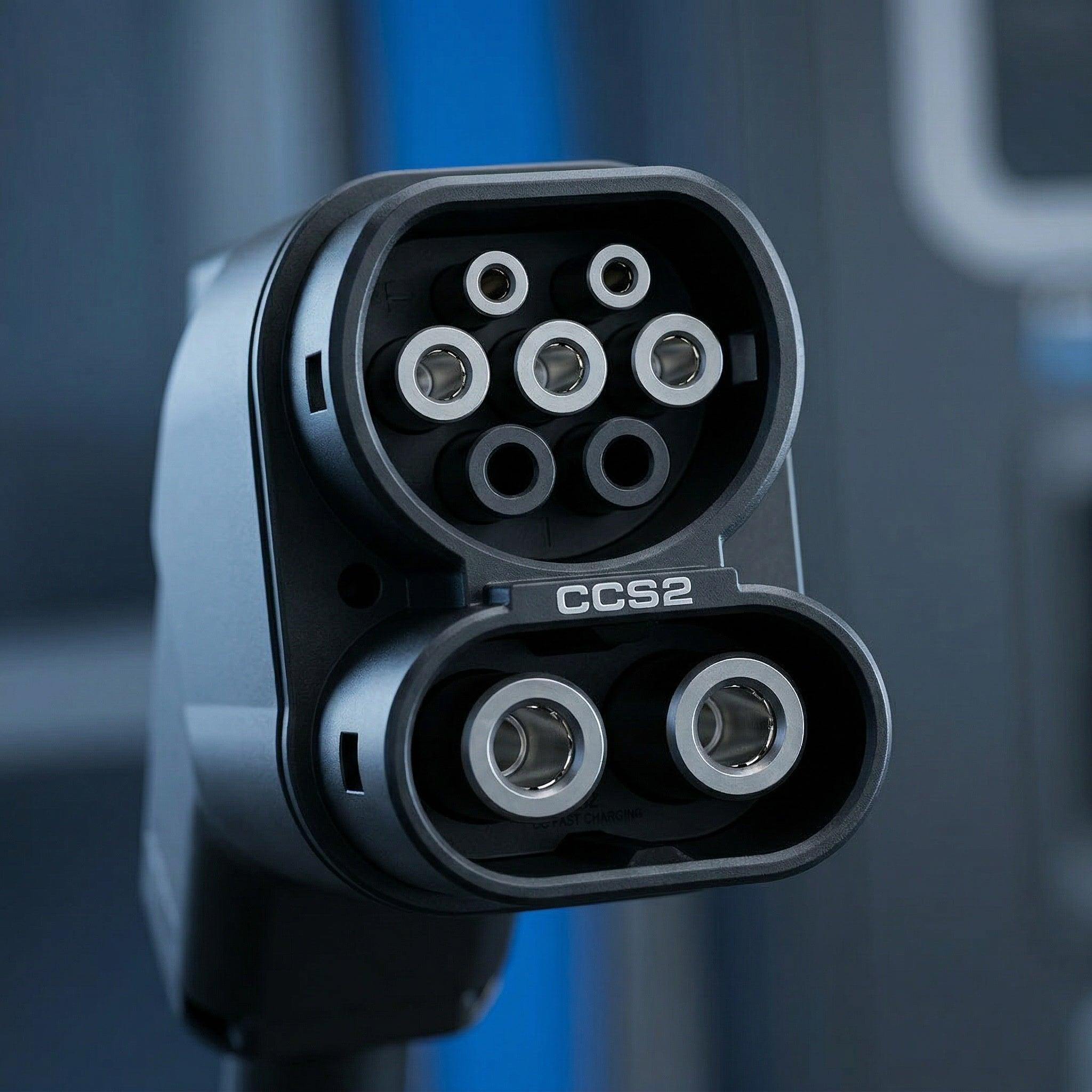
https://voldt.pl/collections/szybka-ladowarka-do-samochodu-elektrycznego
For a connector reference, see CharIN's overview of charging connectors.
How CCS2 DC Fast Charging Works
- Park safely, switch the vehicle to Park, and open the charging port.
- Insert the CCS2 connector fully into the compatible vehicle inlet.
- Start the session using the charging operator's app, card, screen, or other supported method.
- The vehicle and charger communicate and check whether charging can begin safely.
- The station delivers DC power while the vehicle manages how much it can accept.
- Charging power may change as battery temperature and charge level change.
- End the session, wait for the connector to unlock, and return the cable to its holder.
The car's Battery Management System (BMS) helps control charging to protect the battery. A station's advertised rating is not a promise that the car will receive that much power throughout the session.
Understanding Charging Power: kW and kWh
- kW (kilowatt) describes charging power, or how quickly energy is delivered.
- kWh (kilowatt-hour) describes energy, such as battery capacity or the energy added during a session.
For example, a charger delivering an average of 50 kW for 30 minutes supplies roughly 25 kWh before accounting for losses and other limitations.
Public DC chargers may be rated at 30 kW, 50 kW, 60 kW, 120 kW, 150 kW, or higher. Your actual charging power depends on your BYD model, battery condition, the station's available output, and other limits.
Example: A car capable of accepting up to 80 kW will not automatically charge at 150 kW just because it is connected to a 150 kW station.
How Long Does DC Fast Charging Take?
Charging time depends on battery capacity, starting charge level, temperature, and the average power delivered during the session.
Consider a hypothetical EV with a 60 kWh usable battery. Charging from 20% to 80% adds about 36 kWh to the battery.
- At an average of 30 kW, the idealized time is about 72 minutes.
- At an average of 50 kW, the idealized time is about 43 minutes.
- At an average of 60 kW, the idealized time is about 36 minutes.
- At an average of 80 kW, the idealized time is about 27 minutes.
These are illustrations, not BYD model specifications. Real charging can take longer because power is not constant and the system has losses.
Why Charging Often Slows Near 80%
EV batteries do not normally charge at their maximum speed from empty to full. Fast charging often starts relatively quickly when conditions are favorable and then slows as the battery fills. The vehicle reduces power to manage battery voltage, heat, and long-term battery health.
For road trips, stopping a session around 80% can sometimes be more time-efficient than waiting for 100%. However, charging farther may be worthwhile if the next available station is distant. Follow your vehicle's manual for any recommended full-charge or battery-calibration practices.
Are All BYD Vehicles Compatible With CCS2?
No. Charging connectors and power limits differ by model, trim, production year, and intended market. BYD vehicles imported from other markets may use different charging standards, including GB/T.
Before using a CCS2 DC station, confirm:
- Your vehicle has a CCS2 DC inlet, not merely a Type 2 AC inlet.
- Your exact model and variant support DC charging at that station.
- The station's voltage and communication requirements are compatible.
- The connector is undamaged and fits without force.
For an example of model-specific differences, BYD's Singapore-market 2025 ATTO 3 specification lists CCS2 DC charging up to 88 kW. That figure must not be assumed to apply to every Philippine-market ATTO 3 or every BYD variant. See the BYD ATTO 3 2025 specification sheet.
CCS2 DC Versus Type 2 AC
- CCS2 DC: Usually best for quicker top-ups while traveling. Charging equipment is larger and charging can cost more, depending on the operator.
- Type 2 AC: Usually suited to overnight charging or longer parking at home, work, or a destination. Charging speed is limited by the vehicle's onboard AC charger and the charging equipment.
Both can be useful. Choosing between them depends on how long you can park, whether a suitable charger is available, and what your vehicle supports.
Is DC Fast Charging Safe for a BYD Blade Battery?
Compatible, properly maintained DC charging equipment is intended for normal EV use. The vehicle's BMS and thermal management systems monitor charging conditions, including battery temperature and voltage.
To charge responsibly:
- Use charging stations and connectors that match your vehicle's specifications.
- Avoid equipment with damaged cables, plugs, or exposed parts.
- Do not use charging equipment in flooded or otherwise unsafe conditions.
- Do not pull out a locked connector or force a connection.
- Follow vehicle-specific instructions for charging habits and battery maintenance.
Using DC charging when needed is normal. However, charging behavior and battery wear are affected by temperature, charging power, time at high charge levels, and many other factors.
Common CCS2 Charging Problems
- Charging will not start: Check the station's payment or activation process, reconnect correctly, and follow any error message.
- Charging is slower than expected: High battery charge level, battery temperature, shared station power, or charger limitations may be responsible.
- Charging stops unexpectedly: Check both the vehicle and station for warnings. Contact the operator if the fault persists.
- The connector will not release: End the session correctly and wait for the vehicle to unlock it. Consult the vehicle manual; never force it out.
- The plug does not fit: Stop immediately. The connector may be a different standard, or the inlet may not support CCS2.
Using Public DC Chargers in the Philippines
Before starting a long trip, check the charging operator's latest information rather than assuming every listed charger is working or accessible.
- Check that the station offers a CCS2 DC connector.
- Review its location, operating hours, and any parking restrictions.
- Check charging fees, including possible parking or idle fees.
- Confirm whether you need an app, account, card, or specific payment method.
- Identify another suitable charging location in case the first station is occupied or offline.
- Arrive with enough remaining range to reach an alternative charger safely.
Frequently Asked Questions
Can I use a 150 kW CCS2 charger if my BYD supports only 60 kW DC?
Generally yes, if the vehicle and charger are fully compatible. The charging system should limit power to what the vehicle and station can safely provide.
Can CCS2 charge a battery to 100%?
Yes, when supported by the vehicle and charger. The final portion of the session may be much slower than the middle portion.
Is a Type 2 AC plug the same as a CCS2 DC plug?
No. CCS2 includes additional large DC contacts below the Type 2 section. A Type 2-only AC inlet does not automatically support CCS2 DC charging.
Can I charge while it is raining?
Properly installed outdoor chargers are designed to operate under normal weather conditions. Never use visibly damaged equipment or a charger in flooded conditions, and follow posted safety instructions.
Does a more powerful charger always mean a shorter charging session?
No. Charging speed depends on the car's limits and charging curve, not just the charger's advertised kW rating.
Conclusion
CCS2 DC charging makes longer EV journeys more practical by allowing compatible BYD vehicles to add energy faster than with typical AC charging. The essential points are to check your vehicle's exact charging connector and DC power limit, understand why charging speed changes during a session, and confirm public charger details before traveling.
For BYD owners in the Philippines, the safest reference remains the owner's manual and specifications for the exact vehicle variant.
Sources and Further Reading
Community knowledge, not official manufacturer guidance. When in doubt, consult an authorized service center.